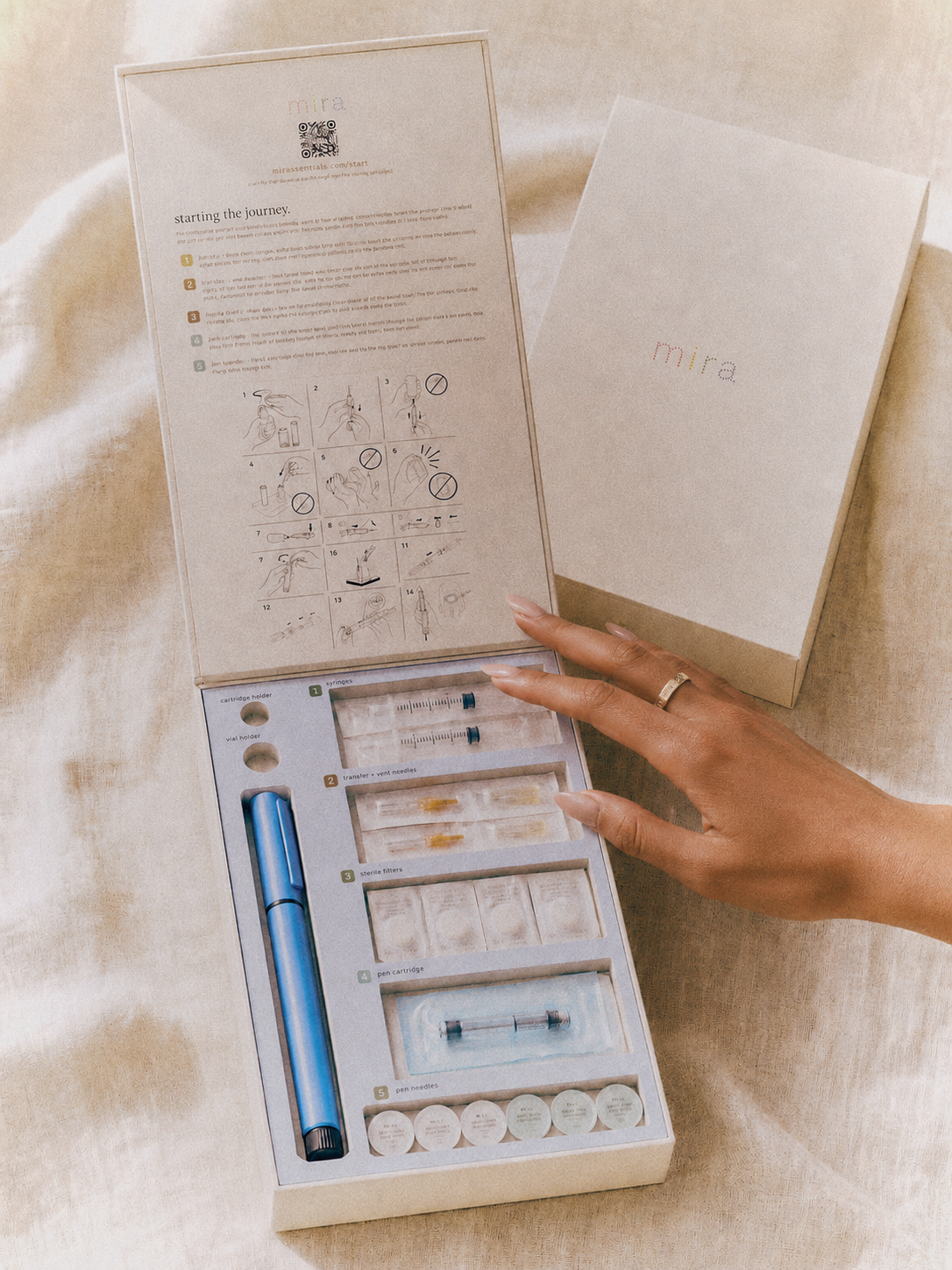
The Mira Box open on linen, the illustrated walkthrough inside the lid and the numbered tray of sterile sundries
the box

feel like yourself again.

everything in this box exists to get your dose from a sealed vial into the pen, cleanly and calmly. the words below name each piece, and the steps that follow put them in order. read the whole thing once before you open anything, then work through it slowly the first time.

$129
one time · ships free

calm, private, and handled.

miraessentials.com/start the walkthrough films every step of the ritual, and the calculator turns your prescription into the only two numbers you need: how much bac water to add, and how many units to dial.

starting the journey.

everything in this box exists to get your dose from a sealed vial into the pen, cleanly and calmly. nothing here is complicated. it is a sequence, and the sequence is always the same: measure the water, mix the powder, filter what you made, fill the pen, dose. once you have done it once, it takes a few quiet minutes.

the pieces are laid out in the tray in the order you use them, top to bottom, and each one is numbered and colour-coded to match the step it belongs to. you do not need to remember anything. you need to work down the tray.

read this whole page once before you open anything. the first time, go slowly and keep the filmed walkthrough open beside you. by the third time you will not need either.

what mira sends, and what it does not

mira sends the devices and the sundries: the pen, the syringes, the needles, the filters, the pads, the cartridges, the tray that holds them and the guidance that explains them. mira does not send the compound, any medication, or the bac water. those come from your clinician or your own source.

the flow · 1 draw → transfer → 2 filter → 3 fill → 4 dose

plain words first

the wellness glossary.

each piece, named. the visible line is what is printed on the lid. open any term for what it does and the mistake worth avoiding.

compound

the compound you were prescribed or sourced, supplied as a dry powder in a sealed glass vial. it cannot be dosed as a powder, so it has to be reconstituted, meaning mixed back into a liquid with bac water, before the pen can use it.

what it is · a dry powder in a small sealed glass vial, sitting under a rubber top and a metal collar. it may look like a thin film, a puck, or barely anything at all. all of those are normal.

what it does · nothing, until it is a liquid. a pen cannot dose powder.

reconstitution is simply the word for turning it back into a liquid with bac water. it is the one piece of vocabulary worth learning, because every guide uses it.

never spray water directly onto it, never shake it, and never warm it to speed things up.

bac water

bacteriostatic water, bac water for short. sterile water with a little preservative in it, so the bottle stays clean after a needle goes in. it is the only water used here, never tap, bottled, filtered or distilled.

what it is · sterile water with a small amount of preservative, sold in its own sealed vial with its own rubber top.

what it does · dissolves the powder, and keeps the vial usable after a needle has been through the top more than once. that preservative is the entire point.

using any other water. tap, bottled, filtered, distilled and sterile saline are all wrong, and three of them look identical to bac water in a glass. plain sterile water has no preservative, so anything that gets in stays in.

syringes

the barrels with numbers up the side. they measure the bac water and push it where you want it.

what it is · a clear barrel with a plunger and graduations printed up the side.

what it does · two jobs: measuring, and moving. the number you draw to is the number the calculator gave you.

reading the graduation from an angle. read it straight on, at eye level, with the barrel vertical.

transfer needles

the long ones move liquid between bottles only. one of them becomes your vent.

what it is · the longer, wider needles that screw onto a syringe.

what it does · moves liquid from bottle to bottle. that is all. a transfer needle is never the thing you dose with.

the vent · one of them does a second job in step 3. pushed through the cartridge neck and left there, it gives trapped air a way out while liquid goes in. without it, pressure builds and the liquid pushes back at you.

re-using one across two draws. one needle, one job, then the sharps bin.

filters

a membrane disc punched with holes 0.22 microns across. liquid passes, bacteria and specks do not. clear liquid can still carry both, invisibly, so filtering is never optional here.

what it is · a small disc that screws between the syringe and the needle, holding a membrane with holes 0.22 microns wide, roughly three hundred times finer than a hair.

what it does · liquid goes through. bacteria and undissolved specks do not.

why it matters more than it looks · a mixed vial can be perfectly clear and still carry particles and airborne bacteria picked up while needles went in and out. none of that is visible to you at any point. filtering is the only step that removes it, which is why mira includes filters in every box and never charges extra for them.

forcing it. a filter is designed for one slow, smooth pass in one direction. never push hard, never pull liquid back through it, and never use one twice.

alcohol pads

alcohol wipes. every rubber top gets wiped and left to dry before a needle goes through it.

what it does · cleans the rubber tops before anything pierces them: the compound vial, the bac water vial, the cartridge neck.

wiping and going straight in. it has to dry. wet alcohol on the needle defeats the wipe.

cartridge

the little glass tube that holds your finished mix and clicks into the pen.

what it is · a small glass tube with a rubber neck at one end and a plunger at the other.

what it does · holds the finished, filtered liquid and loads into the pen.

filling it in your hand. it stands in its own well in the tray for exactly this reason, so both your hands are free for the syringe and the vent.

pen

the reusable pen. the cartridge goes in, a fresh pen needle screws on the front, and the dial at the back sets the dose.

what it does · turns the number the calculator gave you into a repeatable action.

storing it with a needle still attached. the needle comes off and goes in the sharps bin every time.

pen needles

the short fine needle that screws onto the pen. a new one every time you dose.

what it does · the only needle used at the dose step, and the only one that is ever fresh out of its wrapper for it.

reusing one. a needle is sharp once. a fresh one every single time, and never put the cap back on by hand: it goes straight into the sharps bin.

units

the numbers you dial on the pen. a unit is a fixed step of liquid, not a millilitre and not a milligram.

units are not millilitres and not milligrams.

a unit is one click of the dial: a fixed, small volume of whatever liquid is in the cartridge. it is a measure of how much liquid, never a measure of how much compound.

that means the same dialled number can be a different amount of compound in two different cartridges. how strong each unit is depends entirely on how much bac water you added when you mixed. more bac water, weaker per unit. less bac water, stronger per unit.

a number a friend dials, or a number from a forum, means nothing for your cartridge. work only from the calculator, and only from the mix you actually made. write down the bac water amount and the date on the vial, and dial from that.

how much bac water

the amount of bac water you add decides how strong each dose is. the mira calculator gives you both numbers: bac water to add, units to dial.

there is no single right amount. there is the amount that makes your prescribed dose land on a clean, easy number of units.

the calculator takes what you were prescribed and gives you both halves of the answer at once, so the two can never drift apart.

changing the water amount later without redoing the units. the two numbers are one number in two parts.

sharps bin

a rigid, sealed container for used needles.

what it does · keeps used sharps out of household bins and away from anyone else.

recapping by hand, or a drinks bottle standing in as a container. an approved container, closed, disposed of the way your area requires.

the tray

the moulded tray holds every piece in the order you use it, top to bottom, with the numbers and colours printed alongside.

the paper sheet over it names each bay. the two small wells at the top are the cartridge holder and the vial holder. the open area beside them is the reconstitution area, where mixing happens.

four numbers, four verbs

the ritual.

before, mix and after are deliberately unnumbered. they are preparation and care, not steps in the chain.

before

wash your hands. clear a hard surface and wipe it. put the tray where you can reach it.

take the compound vial and the bac water out of the fridge and let both come to room temperature. cold liquid mixes badly and cold glass fogs.

flip the plastic cap off both vials, wipe both rubber tops with a pad, and let them dry. have the sharps bin open before you start, not after.

rush the first time, work over a sink, or start with the door open and the dog in the room. this wants a few quiet minutes.

1

draw

screw a long needle onto a syringe. pull the plunger to your number, push that air into the bac water bottle, turn it upside down and pull the bac water in slowly. then put the needle through the middle of the powder bottle’s rubber top and let the bac water run down the inside of the glass. never spray it straight onto the powder.

  1. screw a transfer needle onto a syringe until it is snug. leave the cap on until you need it.
  2. pull the plunger back to the number the calculator gave you. that is air, and it is deliberate.
  3. push the needle through the middle of the bac water vial’s rubber top and push the air in. this replaces the volume you are about to remove, so the bottle does not fight you.
  4. turn the bottle upside down, keep the needle tip in the liquid, and pull the plunger back slowly to your number.
  5. bring the syringe back upright, tap the barrel so any air rises, and press gently until it is gone.
  6. push the needle through the middle of the compound vial’s rubber top, tilt the vial, and let the bac water run slowly down the inside wall of the glass.

spray the stream straight onto the powder, push the plunger hard, or use anything other than bac water.

mix

take the needle out and put it in the sharps bin.

hold the vial between finger and thumb and roll it slowly, tilting as you go. give it time. some compounds clear in seconds, some take a few minutes. it is ready when the liquid is completely clear with nothing swirling in it.

shake it. shaking foams the liquid and damages what you just paid for. if it has foamed, let it settle before going on. if it will not clear, or there are visible bits left after several minutes, stop and ask your clinician. do not filter your way past it.

2

filter

draw all of the clear liquid back into the syringe. take the needle off, screw a filter on in its place, then a fresh needle on the far side of it. the liquid is not filtered yet: it filters as you push it into the cartridge in step 3. use a new filter each time you mix.

  1. with a fresh transfer needle on the syringe, draw all of the clear liquid back out of the vial. tilt the vial and keep the tip low so you get the last of it.
  2. unscrew the needle and put it in the sharps bin.
  3. screw a filter onto the syringe in its place.
  4. screw a fresh needle onto the far side of the filter. the stack is now syringe → filter → needle.

the liquid is not filtered at this point. this step builds the stack. the filtering itself happens on the push in step 3, which is why the two steps are written to read together.

reuse a filter, use one for a second mix, or assemble the stack in the wrong order.

3

fill

wipe the cartridge neck with a pad and stand the cartridge in its holder. push a bare needle through the rubber neck and leave it there, so trapped air has a way out. put the filter needle through the same rubber and press slowly, one smooth pass, letting the filter do the work: never force it, never pull liquid back through it. pull the filling needle out first, then the vent.

  1. wipe the cartridge neck with a pad and let it dry.
  2. stand the cartridge in the small well in the tray, so it holds itself up and both your hands are free.
  3. take a bare transfer needle, push it through the rubber neck, and leave it there. that is your vent: it gives trapped air a way out as liquid goes in.
  4. push the needle on the end of your filter stack through the same rubber, beside the vent.
  5. press the plunger slowly and steadily, one smooth pass, and let the filter set the pace. this is the moment the liquid is actually filtered.
  6. when the syringe is empty, pull the filling needle out first, then the vent.
  7. everything used goes in the sharps bin.

force the plunger, pull liquid back through the filter, fill without a vent, or hold the cartridge in your hand while you do it.

4

dose

slide the cartridge into the pen, narrow end first, and twist on a new pen needle. hold the pen tip up, dial a couple of units and press until a drop appears, then dial your dose and give it. the used needle goes in a sharps bin.

  1. slide the filled cartridge into the pen, narrow end first, and close the pen.
  2. twist a fresh pen needle onto the front, straight and snug.
  3. hold the pen with the tip pointing up, dial a small number of units, and press until a drop appears at the tip. that is priming, and it proves the path is clear and the air is out. if nothing appears, prime again.
  4. dial the dose the calculator gave you and give it, following the guidance that came with your compound.
  5. take the needle off and put it in the sharps bin. never recap by hand.

reuse a pen needle, skip the prime, or dial a number from anywhere except your own calculation.

after

write the bac water amount and the date on the vial the moment you finish mixing. future you will not remember.

the vial and the loaded pen go back in the fridge, upright, away from the freezer wall.

look at the liquid before every dose. clear is fine. cloudy, coloured, or anything floating in it means stop and ask your clinician.

share the pen. it stays yours alone, for any reason.

the same everywhere

the numbered system.

the same four numbers, verbs and colours run across the box interior, the tray insert, the tray itself and this page.

#verbpieces it belongs tocolour
beforehands, surface, pads
1drawsyringes, bac water sage
mixthe reconstitution area
2filtersterile filters dusty rose
3fillcartridge, vent needle, pads warm tan
4dosepen needles, the pen mint
afterfridge, sharps bin, the label

transfer and vent needles sit between 1 and 2 and are deliberately unnumbered: they are used in more than one step.

mira supplies the devices and sundries for the ritual, never the compound, medication or bac water. nothing here is medical advice or a prescription. talk to a licensed clinician before you start, follow the guidance that came with your compound, keep everything out of reach of children, and dispose of sharps in an approved container.